|
Chinese
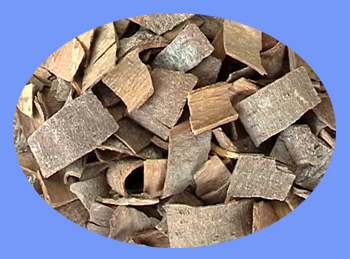
Cassia Bark (rou gui)
Cortex
Cinnamomi
Properties:
The bark is pungent and sweet in flavour, and not in
nature. It acts on the heart, spleen, liver and kidney
channels. As a pungent, sweet, extremely hot and pure Yang
herb, Chinese cassia bark in similar to but slightly
weaker than prepared aconite root in supplementing fire
and dispersing cold. However, the bark has a mild and
lasting effect, and can conduct the fire back to its
origin. Therefore, it is often used to treat
Yang-deficiency of the spleen and kidney, decline of the
fire from the gate of life, pains due to cold, and Yang
being expelled externally by Yin-excess in the interior,
and other syndromes.
Effects:
Supplementing fire, supporting Yang, dispersing cold,
alleviating pain, and conducting the fire back to its
origin.
Indications:
1. To treat
deficiency of kidney-yang and decline of the fire from the
gate of life, with symptoms of cold pain in the waist and
knee, micturition and impotence, or upward floating of
Yang in deficiency condition, heat in the upper and cold
in the lower, the bark is often used in combination with
prepared aconite root, prepared rehmannia root, Chinese
yam and other herbs for tonifying the kidney and
supporting Yang, such as Guifu Bawei Decoction and Yougui
Pill.
2. The herb is
often used in combination with dried ginger, dangshen,
white atractylodes rhizome and other herbs for warming the
middle-jiao, dispersing cold, strengthening the spleen and
arresting diarrhea, to treat cold of deficiency type in
the middle-jiao, stomachache and diarrhea; with evodia
fruit, nutgrass flatsedge rhizome, chuanxiong rhizome and
other herbs for warming the channels, dispersing cold and
alleviating pain, to treat amenia and menorrhalgia due to
cold; with common fennel fruit, evodia fruit, corydalis
tuber and other herbs for warming the liver, dispersing
cold, promoting Qi circulation and alleviating pain, to
treat accumulation of cold in the liver channels,
abdominal colic due to invasion of cold, and abdominal
pain; and with ledebouriella root, asarum herb,
notopterygium root and other drugs for expelling with and
dampness, to treat damp arthralgia due to wind-cold.
In addition, used
in combination with other herbs for supplementing Qi and
nourishing blood, it can promote generation of Qi and
blood, and treat chromic skin and external diseases, cold
of insufficiency type in Qi and blood, chronic ulcer, or
weakened resistance due to chronic illness, and deficiency
of both Qi and blood.
Dosage and
Administration: 2-5g put in
decoction later, Ground into powder and orally taken
following infusion with boiling water, 1-2g each time. The
dosage of Guangui should be doubled because its potency is
weak.
Precautions:
Since the herb is pungent and hot, which supports fire and
activates blood, it is contraindicated in Yin-deficiency,
excessive fire and bleeding tendency, and should used
cautiously in pregnancy.
---------------------------------------------------------------------------------------------- |