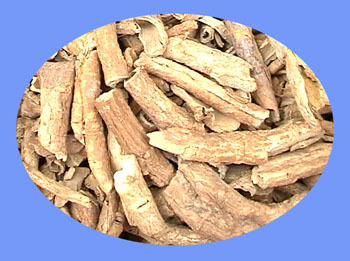
Acanthopanax
Bark
(wu jia pi)
Cortex
Acanthopanacis Radicis
Properties:
Pungent and bitter in flavour, warm in nature, it acts on
liver and kidney channels. Being pungent for dispersing
exopathogens, bitter and dry for eliminating dampness,
warm for dispersing cold and tonifying liver and kidney,
muscles and tendons, the herb is suitable for syndromes of
prolonged wind-dampness disease, muscular spasm,
deficiency of liver and kidney, asthenia of muscle.
Effects:
Expelling wind-dampness, thonifying the muscle and bone,
diuresis to alleviate edema.
Indications:
1. For arthralgia caused by
wind-dampness with protracted course and deficiency of
liver and kidney, it is used together with achyranthes and
cyathular root (Radix Achyranthis bidentatae et Radix
Cyathulae), eucommia bark (Cortex Eucommiae) and morinda
root (Radix Morindae officinalis) to expel the
wind-dampness, tonify the liver and kidney.
2. For insufficiency of liver and
kidney, asthenia of muscle, retardation due to infantile
insufficiency of kidney, it is used together with
achyranthes and cyathula root (Radix Achyeanthis
bidentatae et Radix Cyathulae), chaenomeles fruit (Fructus
Chaenomelis), loranthus mulberry mistletoe (Ramulus
Loranthis) and tiger bone (Os Tigris) to nourish the
kidney, strengthen the muscle and bone.
3. For edema and difficulty in
urination due to deficiency of spleen and stagnation of
dampness, it is used in combination with white
atractylodes rhizome (Rhizoma Atratylodis macrocephalae)
and poria (Poria) to tonify Qi, eliminate liquid retention
and relieve edema.
Dosage and Administration:
5-10g. As it is toxic, the large dosage should be avoided.
----------------------------------------------------------------------------------------------