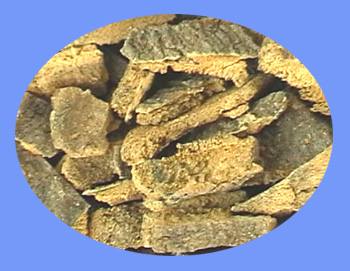
Ailanthus Bark (chun gen pi)
Cortex Ailanthi
Properties:
Bitter and astringent
in flavour, cold in nature, it is tropistic to the large
intestine anad liver channels. Being bitter and
astringent in flavour and cold in nature it can
eliminate dampness, astringe and clear away heat. It
acts on the qi-division of the large intestine channel
to eliminate heat and dampness and arrest leukorrhagia
and diarrhea; acts on the blood division of the liver
channel to remove pathogenic heat from blood and stop
bleeding, to treat leukorrhagia, metrstaxis and
hemafecia due to blood-heat.
Effects:
Clearing away heat and dampness, removing heat from the
blood to stop bleeding, arresting leukorrhagia and
diarrhea.
Indications:
1. For chronic diarrhea and dysentery, it is used with
herbs for replenishing Qi and warming the middle-jiao,
astringing intestines to arrest diarrhea, such as
Fructus Chebulae, Flos Caryohylli, Fructus Schisandrae,
Rhizoma Zingiberis, and Radix Codonopsis, etc. For
dysentery due to damp-heat it is used together with
Radix Sanguisorbae or with other herbs for eliminating
heat and dampness, such as Radix Scutellariae, Rhizoma
Coptidis and Radix Aucklanciae. For dampheat leukorrhea,
it can be used with heat-clearing and dampness-drying
herbs, such as Cortex Phellodendri, Rhizoma Atractylodis,
Semen Plantaginis, Semen Euryales, etc.
2. For menorrhagia, metrorrhagia and metrostaxis due to
blood-heat, it is often used with heat-clearing
blood-cooling, metrorrhagia-arresting and hemostatic
herbs, such as Radix Scutellariae, Cortex Phellodendri,
Colla Plastric Tesudinis, Radix Paeoniae Alba, etc.
Dosage and Administration:
10-15g.